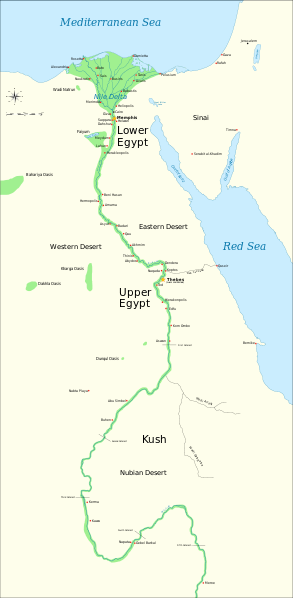
Old Kingdom of Egypt
is the name given to the period in the 3rd millennium BC when Egypt attained its first continuous peak of civilization – the first of three so-called "Kingdom" periods, which mark the high points of civilization in the lower Nile Valley (the others being Middle Kingdom and the New Kingdom). The term itself was coined by eighteenth-century historians and the distinction between the Old Kingdom and the Early Dynastic Period is not one which would have been recognized by Ancient Egyptians. Not only was the last king of the Early Dynastic Period related to the first two kings of the Old Kingdom, but the 'capital', the royal residence, remained at Ineb-Hedg, the Ancient Egyptian name for Memphis. The basic justification for a separation between the two periods is the revolutionary change in architecture accompanied by the effects on Egyptian society and economy of large-scale building projects
The Old Kingdom is most commonly regarded as the period from the Third Dynasty through to the Sixth Dynasty (2686–2181 BC). Many Egyptologists also include the Memphite Seventh and Eighth Dynasties in the Old Kingdom as a continuation of the administration centralized at Memphis. While the Old Kingdom was a period of internal security and prosperity, it was followed by a period of disunity and relative cultural decline referred to by Egyptologists as the First Intermediate Period.[2] During the Old Kingdom, the king of Egypt (not called the Pharaoh until the New Kingdom) became a living god who ruled absolutely and could demand the services and wealth of his subjects.[3] The numerous references to the Old Kingdom kings as pharaohs in this article stems from the ubiquitous use of the term "pharaoh" to describe any and all Ancient Egyptian Kings.

No comments:
Post a Comment