New Kingdom of Egypt
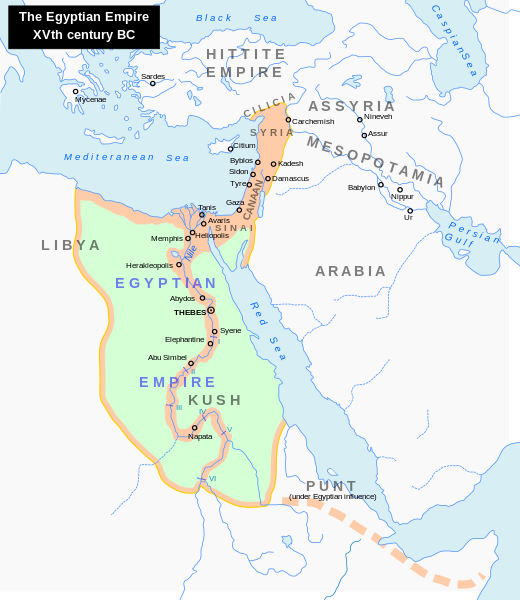
The New Kingdom of Egypt, also referred to as the Egyptian Empire, is the period in ancient Egyptian history between the 16th century BC and the 11th century BC, covering the Eighteenth, Nineteenth, and Twentieth Dynasties of Egypt. Radiocarbon dating places the exact beginning of the New Kingdom between 1570–1544 BC.[1] The New Kingdom followed the Second Intermediate Period and was succeeded by the Third Intermediate Period. It was Egypt’s most prosperous time and marked the peak of its power.[2]
The later part of this period, under the Nineteenth and Twentieth Dynasties (1292–1069 BC) is also known as the Ramesside period. It is named after the eleven pharaohs that took the name of Ramesses I, founder of the 19th Dynasty.
Possibly as a result of the foreign rule of the Hyksos during the Second Intermediate Period, the New Kingdom saw Egypt attempt to create a buffer between the Levant and Egypt, and attained its greatest territorial extent. Similarly, in response to very successful 17th century attacks by the powerful Kingdom of Kush,[3] the New Kingdom felt compelled to expand far south intoNubia and hold wide territories in the Near East. Egyptian armies fought Hittite armies for control of modern-day Syria.
| Name of King | Throne Name | Date | Burial | Queen(s) |
|---|---|---|---|---|
| Ramesses I | Menpehtire | 1292–1290 BC | KV16 | Sitre |
| Seti I | Menmaatre | 1290–1279 BC[4] | KV17 | (Mut-)Tuya |
| Ramesses II | Usermaatre Setepenre | 1279–1213 BC | KV7 | Nefertari Isetnofret Maathorneferure Meritamen Bintanath Nebettawy Henutmire |
| Merneptah | Baenre Merynetjeru | 1213–1203 BC | KV8 | Isetnofret II |
| Seti II | Userkheperure | 1203–1197 BC | KV15 | Twosret Takhat Tiaa |
| Amenmesse | Menmire-Setepenre | 1201–1198 BC | KV10 | Unknown |
| Siptah | Sekhaienre Meryamun / Akhenre Setepenre | 1197–1191 BC | KV47 | Unknown |
| queen Twosret | Sitre Meritamun | 1191–1189 BC | KV14 | None |
Pharaohs of the 20th Dynasty[edit]
The Pharaohs of the 20th dynasty ruled for approximately 120 years: from ca. 1187 to 1064 BC. The dates and names in the table are mostly taken from "Chronological Table for the Dynastic Period" in Erik Hornung, Rolf Krauss & David Warburton (editors), Ancient Egyptian Chronology (Handbook of Oriental Studies), Brill, 2006. Many of the pharaohs were buried in the Valley of the Kings in Thebes (designated KV). More information can be found on the Theban Mapping Project website.[1]
| name of King | Throne Name | date | Burial | Queen(s) |
|---|---|---|---|---|
| Setnakhte | Userkhaure | 1189 – 1186 BC | KV14 | Tiy-merenese |
| Ramesses III | Usermaatre-Meryamun | 1186 – 1155 BC | KV11 | Iset Ta-Hemdjert Tiye |
| Ramesses IV | Usermaatre (later Heqamaatre) Setepenamun | 1155 – 1149 BC | KV2 | Duatentopet |
| Ramesses VAmenhirkhepeshef I | Usermaatre Sekheperenre | 1149 – 1145 BC | KV9 | Henutwati Tawerettenru |
| Ramesses VIAmenhirkhepeshef II | Nebmaatre Meryamun | 1145 – 1137 BC | KV9 | Nubkhesbed |
| Ramesses VII Itamun | Usermaatre Setepenre Meryamun | 1136 – 1129 BC | KV1 | |
| Ramesses VIIISethhirkhepeshef | Usermaatre Akhenamun | 1130 – 1129 BC | ||
| Ramesses IX Khaemwaset I | Neferkare Setepenre | 1129 – 1111 BC | KV6 | Baketwernel |
| Ramesses XAmenhirkhepeshef III | Khepermaatre Setepenre | 1111 – 1107 BC | KV18 | Tyti |
| Ramesses XI Khaemwaset II | Menmaatre Setpenptah | 1107 – 1077 BC | KV4 | Tentamun |
Background[edit]
Pharaoh Setnakhte was likely already middle aged when he took the throne after Queen Twosret. He ruled for only around 4 years when he was succeeded by his son Ramesses III. Egypt was threatened by the Sea Peoples during this time period, but Ramesses III was able to defeat this confederacy from the Near East. The king is also known for a harem conspiracy in which Queen Tiye attempted to assassinate the king and put her son Pentawere on the throne. The coup was not successful in the end. The king may have died from the attempt on his life, but it was his legitimate heir Ramesses IV who succeeded him to the throne. After this a succession of kings named Ramesses take the throne, but none would truly achieve greatness.[2]
///////////////////////////

No comments:
Post a Comment